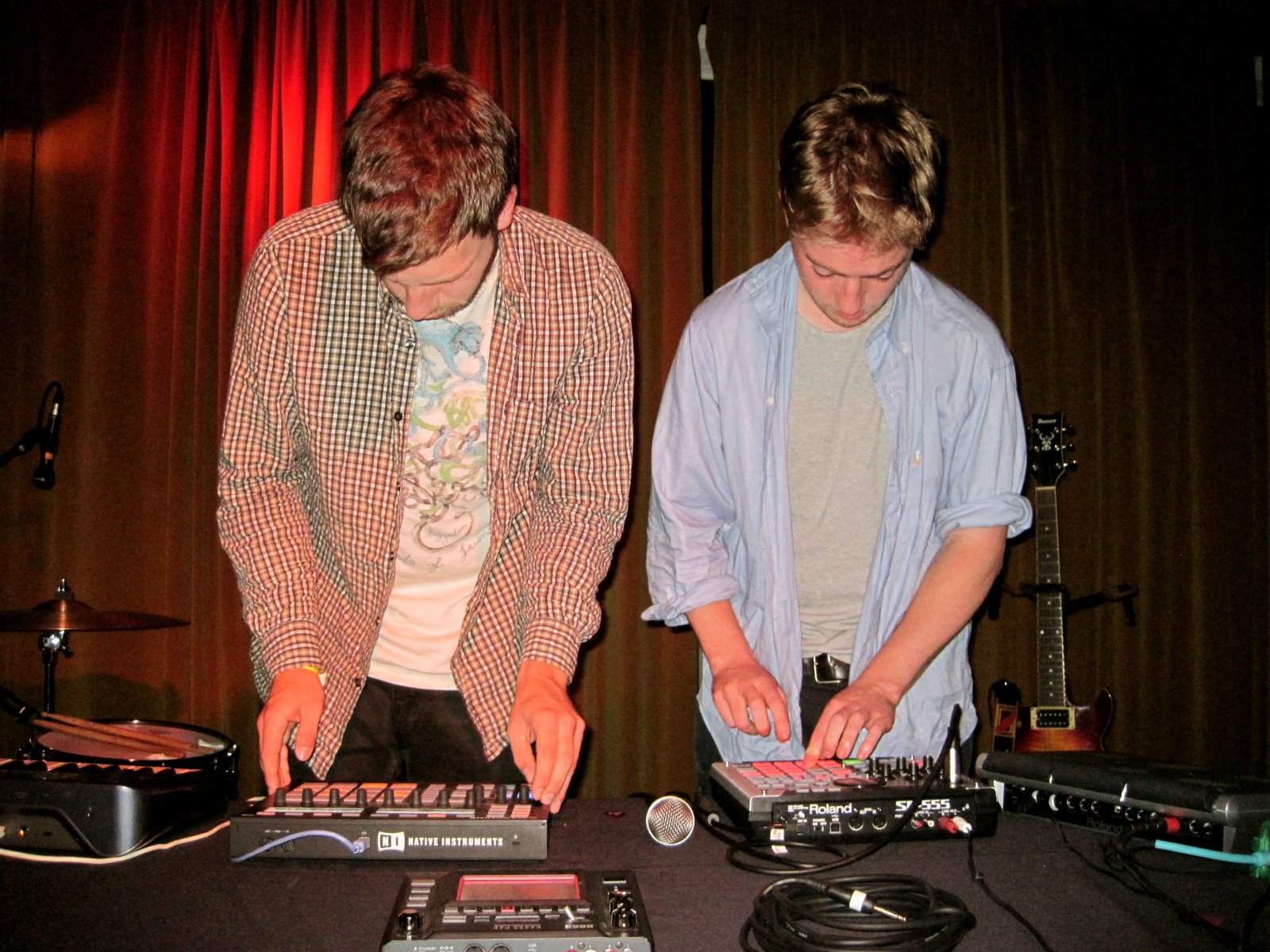
Dom Maker and Kai Campos, better known as Mount Kimbie, made their Toronto debut at the Drake Underground this Thursday night and did not disappoint. The young UK duo played a live set free of laptops, using a Native Instruments sampler, a Roland SP-555, and a KORG Kaoss pad, as well as, real guitar, synth and drums, they managed to create an interesting and varied live version of their clipped paced dubstep sound. Tracks like “Carbonated”, “Field” and “Ode to Bear” sounded great live, with tweaked samples, live instrumentation, additional beats, and deep bass. The opening seconds of “Maybes” sounded downright cavernous in the dark and packed Drake Underground, and the vocal samples swirled and panned around the room. The live version of “William” featured Dom singing the muted lyrics with his thick British accent, which I thought was a nice touch. Although their set was relatively short, and perhaps at times just a bit too low on the bpms for the ravenous crowd, it was great to see these guys play live in a small venue. Nice stuff.
Local hero mymanhenri got the show going, playing great tracks by all our faves including FlyLo, Floating Points, and Onra, who will also be making his Toronto debut at the Drake Underground on Oct 10th. Another one you should not miss. Check it.
The buzz has been building for fledgling Chelmsford, Essex producer Gold Panda for awhile now, and after lauded remixes for the likes of Bloc Party, Simian Mobile Disco, HEALTH, and Lemonade (to name a few), as well as the release of some quality singles, Gold Panda has dropped his debut album Lucky Shiner on the cusp of autumn.
For those of you unfamiliar with Gold Panda’s sound, an immediate reference point could be imagining the gifted lovechild of Four Tet and The Field. But this is not to imply that GP sounds too much like either of these artists, just that his music evokes them. Therefore, beatier tracks like “Vanilla Minus”, “Snow & Taxis”, and “Marriage” will no doubt remind listeners of The Field’s knack for hypnotic loop-based techno. Yet what makes it different is Gold Panda’s talent for adding a distinct emotional element to his songs, one that is quite strong but doesn’t fully reveal itself until repeated listens.
Gold Panda’s ability to eke out emotion, coupled with a quirky, more abstract air, is where the Four Tet comparison comes in — with tracks like “Same Dream China”, “After We Talked”, and the already revered “You”, being excellent examples of this side of Gold Panda’s musical palette. “Same Dream China” is an early highlight, which features Steve Reich chimes that build on a loop, subtle bass, and a tweaked sample of a traditional stringed Chinese instrument. It’s one of those tracks that might elude you at first, but after a few spins have you playing on repeat.
There really is something infectious with Lucky Shiner, which simply comes down to the fact that it invokes an introspective yet warm mood in the end — one that seems to correspond snugly with the beginning of the autumn season. There are no lyrics throughout the album, but it still plays out as deeply personal, and judging by the track titles this seems to be the case. Hence, what we have is a smattering of Gold Panda’s autobiography thus far, told aurally rather than orally, with a touch of his passion for Eastern cultures thrown in for good measure. Lucky Shiner is a solid and diverse debut, and worth every bit of anticipation and hype bestowed upon it. Check it.
Hot on the heels of his critically acclaimed debut album “Skulltaste”, Brian Lindgren aka Mux Mool returns with an EP of remixes, one new track, and his own remix of “Wax Rose Saturday”, which he has dubbed a “remux”. The album opens with Mool’s remux, and you’d never know it came from the original track if he didn’t tell you. This new “Wax Rose” is pure analogue and a much warmer affair than the bleepy original, sounding a bit like labelmate Dabrye, with some smooth vocoder thrown in for good measure. It gets one’s head bobbing, and segues nicely into new track “Valley Girls”, which is one of the best songs he has released to date — a simple slow jam with a subtle yet spooky synthline that bumps so nice you’ll want to play it twice before moving on to the remixes.
Daso’s remix of “Enceladus” is the clear-cut highlight here, a sprawling 7 minute 4/4 banger that has the dancefloor in its sights from the get go. Hints of house and disco are meshed in with Mool’s original dirty funk to smashing effect, creating a definite hitter for all you late-night DJs hoping to carry the party until the wee ones. Shigeto’s take on “Morning Strut” switches the rhythm around while still maintaining the original track’s piano line, while Paul White tweaks “Wolf Tone Symphony” and Alex B tries his hand at “Hog Knuckles” by upping the pitch and tempo, but in my opinion that track is arguably already pitch perfect in its original form. Nevertheless, this is an excellent addendum to Mux Mool’s sound in 2010, and definitely worth checking out.
An absolute and understated classic from Marc Leclair, “Musique Pour 3 Femmes Enceintes” was released in 2005. Leclair is probably best known for his work as tech-house wizard Akufen, but with “Musique” he tapped into something special, and overall it exceeds his work under the Akufen moniker, because it’s much broader in scope and so much more subtle in execution. Yes, I love “My Way”, and when I first saw Akufen play in Detroit in 2002 with Luciano and Dandy Jack at The Works, I thought I’d witnessed the future of techno music. I remember smiling and dancing non-stop and being proud that he was representing Canada and MTL, the city I would move to a year later. And for awhile, Akufen was indeed the shit — his tracks were meticulously produced, uber-groovy, and they bumped hard and heavy — but he was never able to match the grandeur and finesse of “My Way”. His releases afterwards fell flat or felt samey in comparison.
Yet with “Musique Pour 3 Femmes Enceintes” he tapped into a whole new vibe. Leclair seamlessly meshed the ambient with the minimal, and the organic with the digital to smashing effect, and tossed in the conceptual aspect of his wife’s (and 2 friends) pregnancy to go along with it. The album features nine tracks, one for each month and begins almost clinically with “1er jour”, a collaboration with Rechenzentrum featuring very dark and digital programming, presumably signifying the child’s conception. By “64e jour”, the album begins to warm up, with organic ambience and Steve Reich inspired piano patterns. The next two tracks feature the sounds of water, rain, thunder, and begin to slowly open — as if he’s trying to recreate the experience of the nascent child growing in the womb. By “150er jour”, Leclair’s aesthetic palette expands exponentially, adding in guitars, loops, glitched beats, and by the end of the track a soft rolling 4/4 beat.
The album slowly unfolds and evolves from quiet minimal ambience to full on Akufen-inflected tech house by the album’s last track, “236e jour”. The baby is being born, it’s amazing and joyous, and you can’t help but wanna get up and dance. Throughout, Leclair’s knack for production is flawless, and as an album its flow is perfect in execution. I have fallen asleep countless times to this album, but I have also put it on many times as the precursor to a great night out. “Musique Pour 3 Femmes Enceintes” is truly a fantastic electronic album and one that needs to be listened to by more people. It’s never too late to check it.
Electronic duo Zerkalo is a project worth getting excited about. First of all we have production duties from Heinrich Mueller (real name Gerald Brown) of legendary Detroit techno outfit Drexciya, and chilling vocals from French chanteuse Victoria Lukas. The result is that classic Detroit synth sound meshed with dark beats and eerie voice. The mood of Mueller and Lukas’ collaboration can’t help but bring to mind the work of Fever Ray, yet the comparison falls a bit flat, as Fever Ray is more about spectacle, whereas Zerkalo seems more of a multimedia project featuring a cinematic element at live performances that go part in parcel with the music. Either way, the music is great minimal synth-oriented electronica that is reminiscent of the more sedate Drexciya tracks but also sounds like something entirely new from Mueller, and Lukas’ mesmerizing vocals are the perfect extension.
They have released three 12’s thus far through Clone Records and their videos are all worth repeated viewings. I am looking forward to more work from this exciting duo in the near future. If I’ve piqued your interest, then check out an interview with Lukas courtesy of FACT Magazine. Cheers.
Ambient neo-classicist hero, Marsen Jules, made his North American debut at this year’s MUTEK festival in Montreal. Accompanied by twin brothers Anwar and Jan Phillip Alam on violin and piano, Jules had the large crowd enraptured as his emotive and glacial soundscapes swirled and pulsed in the airy Monument-National Theatre.
Marsen Jules is my favourite of all composers in the ever expanding genre of modern classical/ambient music. The opening track on Herbstlaub, “Fanes D’Automne” is the most played track on my iTunes, and his music has sailed me off to sweet dreams many a night, as well as, welcomed the dawn with me on many a morn. So you can imagine how stoked I was to finally experience his music in a live setting. And what a performance it was. Choice of venue had a lot to do with it, and the Monument-National was perfect, providing a large theatre space with phenomenal acoustics. The visuals by VJ Nicolai Konstatinovic were an excellent addition to the concert — showcasing abstract imagery in uber-vivid colour, as well as calming footage of hovering birds and a beautiful steady shot of a local swimming hole somewhere in what I imagined to be a small village in rural France.
It was great to see him do his thing live. Using his computer, a mixing tablet, two glasses of water, two drum cymbals, chimes, and the twin brothers on strings and keys, Jules was able to create a stirring live rendition of his work. Overall, his performance was the highlight of the festival for me, and further proof as to why I think he’s one of the best musicians in the genre.
Unfortunately, the rain stopped me from going to see him play at the Picnic Electronik under his dub-oriented krill.minima guise, but still a great time was had. Check out the remastered version of his first album Yara right now.
Last summer I discovered avant-pop weirdos The Chap, thanks to Ghostly International’s annual Ghostly Swim compilation. Hailing from South London, The Chap craft irreverent and infectious songs that groove and rock and shimmer and bump with nods and influences ranging from post-rock, new wave, electro, punk, funk, techno, folk, and French pop. Wooh. Lemme take a breath.
The Chap are a veritable musical melting pot and they pull it all off with so much style it’s almost as if they have none at all. 2008’s Mega Breakfast and last year’s EP Builder’s Brew are excellent albums that made me dance, head bang, and laugh my ass off on account of some brilliant lyrics. Imagine a dead pan delivery of these lyrics: “Nice Face/ Shame about the haircut/ Good body/ Bad conversation” over a tight 4/4 techno beat for six minutes. Makes me chuckle every time. Their roving hitter “Proper Rock” from Mega Breakfast is so good I imagined it could not be topped, but the band has returned with brand new full length Well Done Europe, and have effortlessly outdone themselves. After a few listens you begin to notice just how incredibly adept they are with regards to composition and the ability to add that little extra something to make each song sparkle and stand out. On the whole, Well Done Europe plays out beautifully all the way through — their isn’t a throwaway guitar lick or snare pop, and although they’ve kept their irreverence and cheekiness intact, the album also manages to pack a solid emotional punch.
“Even Your Friends” is the feel good song of the summer, and makes LCD Soundsystem’s “Drunk Girls” sound flat and dumb in comparison. Its chorus is a rollicking sing-along that you’ll already be singing to yourself before the first listen is done. Yet the catchiness doesn’t stop there. “Obviously”s almost haunting refrain: “Is anybody still out there?” seeps into your brain and stays there, just as the chorus to the groovy “Your Horoscope”: “Get the funk out of here, or my bandwith flows…” will do the same. The penultimate track “Chalet Chalet” perhaps best reveals the group’s maturity, with its ‘forget about it all, let’s get away’ vibe, Stereolab-esque refrain, and buttery guitar line reminiscent of Jeff Parker near the end. Just lovely.
To get a sense of how infectious the album really is, I’ll provide a brief anecdote: Me and my friends Matt and Kristiann went to Montreal for Mutek this weekend (which was awesome btw) and during the drive up we listened to Well Done Europe, smiling and singing along the whole way. On our return to Toronto, we didn’t listen to the album, but only because we were still humming the refrains and choruses lodged in our brains from two days before.
I wanted to put Mega Breakfast on my end of year list for 2009 even though it came out in 2008. As it stands right now, Well Done Europe will be high on my list for 2010. I am ready to go steady with the summer time love that is The Chap’s Well Done Europe. Check it! Now. Please. Yay.
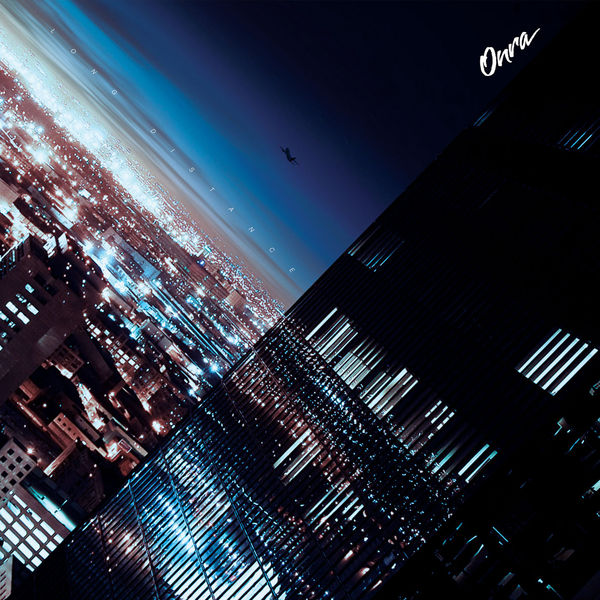
Parisian beat maestro, Arnaud Bernard aka Onra returns with his new full-length, Long Distance. Abandoning the old world samples he used in Chinoiseries, and 1.0.8, Long Distance adopts a smooth 80’s vibe throughout. I imagine it being the sound of the 1980’s New York underground, and Onra lays it on thick and chilled. Dirty funk bass, hand clap beats, soul breaks, old skoool scratching, Lionel Ritchie guitars, moments reminiscent of J.J. Fad and bad 90’s muzak, plus some great guests makes this definitely one to check out.
Listen to “Send Me Your Love” below. I’ve been playing this track on repeat.
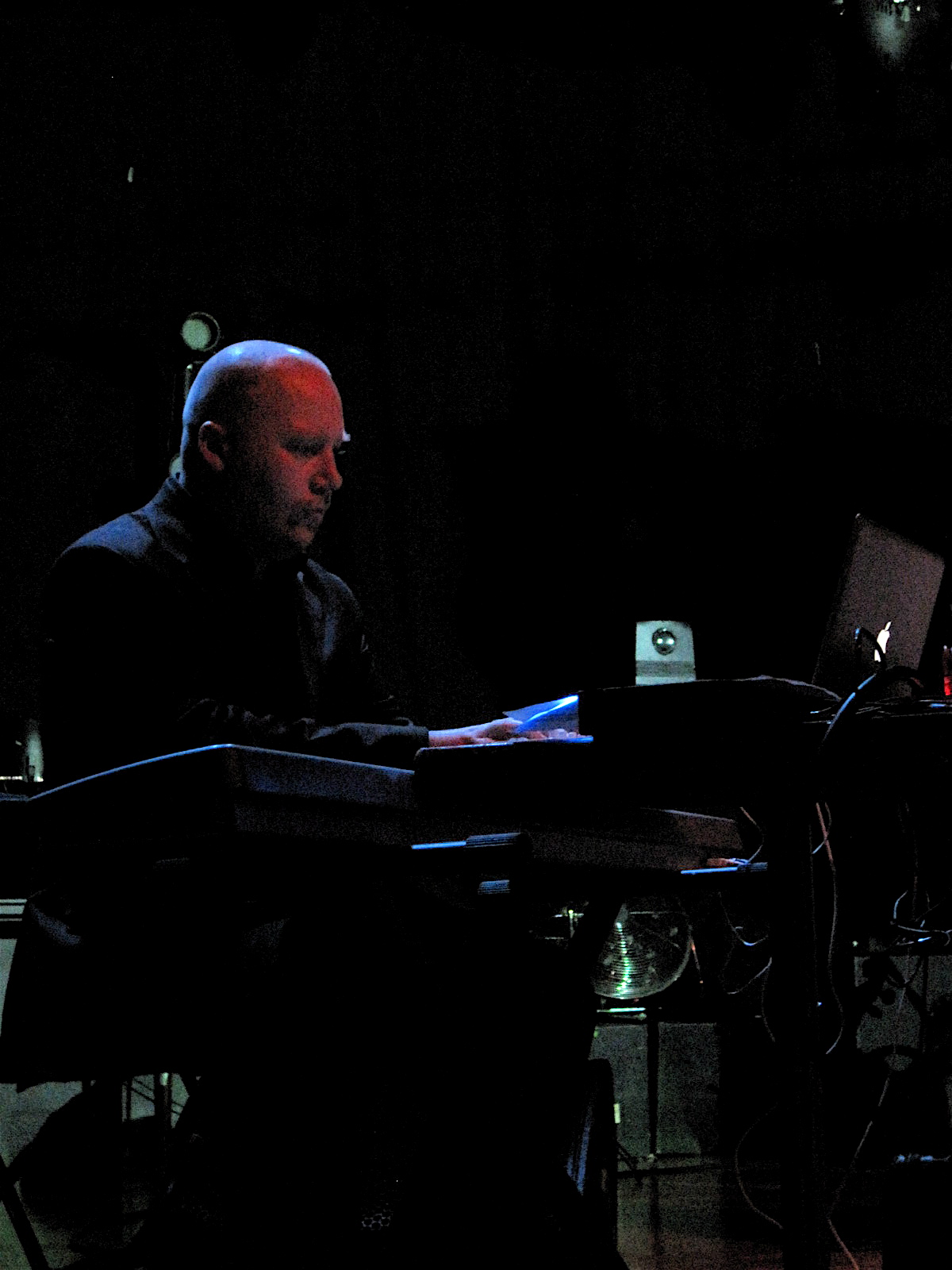
Icelandic composer Jóhann Jóhannsson played his long-awaited Toronto debut at The Mod Club this week to an intimate yet enraptured crowd. Joining him on stage were three violinists, a cellist, and his long-time collaborator Matthías Hemstock, who manipulated sounds and live samples, and the result was a subdued, and beautiful set of neo-classical ambience. Playing compositions from his critically acclaimed Fordlandia, and In the Endless Pause There Came The Sound Of Bees, Jóhannsson sat pretty much motionless behind his gear, allowing the roving emotions in his music to speak for themselves. The string quartet helped make the live show a much more organic experience, and Jóhannsson’s music is so very much alive, this would have been lost if it had been just him up there with his laptop and electric piano.
The set began with the title track from Fordlandia and they played much of the quieter material first. Black and white films played on the wall behind the musicians, which was odd considering there were two large projection screens set up to the left and right of the stage, which remained blank. Tables and chairs were set up for us to sit comfortably through Jóhannsson’s minimal yet swirling arrangements. The highlight of the night was “Guidelines for a Space Propulsion Device” which relies on a loop of bassy synth and patiently grows into an orchestral frenzy, the strings building to a feverish climax, as Hemstock created head-bobbing percussion through live samples.
It was a beautiful show on a warm Tuesday night in Toronto. Very nice.
Warp Records genre-bending producer extraordinaire, Flying Lotus (née Steven Ellison), returns with the follow up to his highly successful and oft imitated Los Angeles with Cosmogramma — arguably the most anticipated electronic album of 2010. And from the opening seconds of first track “Clock Catcher”, it quickly becomes evident that Fly Lo is working on a whole new level of ‘next shit’ here. This may throw some listeners for a loop at first, however, after a couple of listens you’ll begin to understand exactly why Fly Lo has described the album as his “space opera”.
The obvious stylistic difference with Cosmogramma is that it adopts a jazzier feel to it, rather than the fragmented hip-hop of Los Angeles and 1983. Its closest reference point seems to be the stuff a later Miles and Trane would have made if they had access to the technology. The album is definitively out there, and will no doubt be just as railed against as highly lauded by the critics because of this. But for this listener, it’s a fantastically heady album with amazing beats, funked-out basslines (at times reminiscent of Squarepusher), and smooth jazz breaks, and overall it comes across as a much more personal recording for Ellison, as he attempts to tap into his family’s rich musical roots.
Fly Lo is nephew to Alice Coltrane, wife of John, and a highly accomplished jazz musician in her own right (check her out if you never have), and Auntie Alice’s influence is in the forefront here, as he samples her playing the harp, and her son Ravi playing the saxophone throughout. His collab with Thom Yorke is fine, and will no doubt be deemed a highlight, yet tracks like “Zodiac S**t”, “MmmHmm”, “Do The Astral Plane”, and “Recoiled” are major hitters on the record, and all so very different stylistically, you just gotta hear it to believe it. The album ends with “Galaxy in Janaki”, his most hip-hop track on the album, yet instead of it being a dark and ominous closer, it features a swirling symphony, frenetic bass, and seems charged with a bright optimism for the future evolution of his sound. Next shit indeed.






 INAUDIBLE